
Your Complete Morocco Road Trip Itinerary
Best Roads to Drive in Morocco – Top Routes & Tips
Looking for a fast answer? Here are Morocco’s top roads at a glance:
- Best Overall: Tizi n’Tichka Pass – iconic Atlas mountain drive, 195 km
- Most Scenic Canyon: Dadès Gorge (N10) – twisting red rock walls
- Most Dramatic Pass: Tizi n’Test (R403) – 2,100m hairpins, not for beginners
- Best Coastal Drive: Agadir to Essaouira via N1 – Atlantic cliffs and argan forests
- Best Beginner Route: Casablanca to El Jadida (N1) – smooth, scenic, 2 hours
- Best Desert Road: N13 Merzouga – dunes, oases, sunrise views
- Avoid in 2026: R502 High Atlas backroads (flash flood risk post-rains)
Why Morocco Has Some of the World’s Best Driving Roads
Morocco is one of the rare countries where you can drive through a snow-dusted Alpine-style mountain pass in the morning, stop for mint tea in a centuries-old kasbah at noon, and watch the sun melt into the Atlantic by evening – all in the same day. That kind of landscape variety is almost impossible to find anywhere else.
As someone who has helped over 10,000 drivers explore Morocco from Casablanca – through our car rental service in Casablanca – I’ve seen firsthand which roads genuinely deliver and which ones catch visitors off guard. This guide is built on that real experience, not just a list copied from a travel brochure.
Whether you’re planning a quick weekend escape or a two-week road trip, the routes below are the ones that deliver the most – scenic return on every kilometer driven.
Roads to Avoid in Morocco in 2026 (No Other Tells You This)
The most useful thing I can share – based on real driver incidents – is where not to go, at least without proper preparation.
| Road | Risk | Safer Alternative | Notes |
|---|---|---|---|
| R502 High Atlas backroads | Flash flood, landslide (20% closure risk) | Tizi n’Tichka (N9) | Post-rain closures common Oct–Feb |
| N15 Sahara fringe roads | Sand drifts, zero signal | N13 via Merzouga | No tow services for 100+ km |
| Urban bypass routes near Casablanca | Heavy traffic, toll confusion | A1 motorway | Especially during morning rush hours |
| Unpaved Azilal side tracks | Loose gravel, no signage | Ourika Valley R208 | Accessible only with 4×4, seasonally |
The 10 Best Roads to Drive in Morocco (2026 Guide)
1. Tizi n’Tichka Pass (N9) – Morocco’s Most Iconic Mountain Drive
| Detail | Info |
|---|---|
| Distance | 195 km (Marrakech → Ouarzazate) |
| Drive Time | ~4 hours (with stops) |
| Altitude | 2,260m at summit |
| Road Type | N9 / P31 – paved, well-maintained |
| Difficulty | Moderate – suitable for standard cars |
| Best Season | April to October (snow risk Nov–Mar) |
| Recommended Vehicle | Any car – SUV preferred for comfort |
This is the one road that every visitor to Morocco should drive at least once. The N9 climbs through the High Atlas Mountains with sweeping switchbacks, Berber villages perched on cliffs, and the kind of panoramic views that make you pull over every few kilometers.
The route connects Marrakech to Ouarzazate – Morocco’s film capital – passing the UNESCO-listed Ksar of Ait Ben Haddou, which appeared in Gladiator and Game of Thrones. The kasbahs, the ochre landscape, and the high-altitude silence make this more than just a drive.
Planning a one-way car rental from Casablanca to Marrakech before this route is a smart way to avoid backtracking — you can then continue south from Marrakech at your own pace.
What surprised me: The roadside Berber tea stops at the summit. Local vendors serve fresh mint tea with mountain views. It’s unscripted, spontaneous, and completely worth the stop.
Mistake to avoid: Rushing the switchbacks. Trucks use this road heavily. Slow down, enjoy the views, and stay in your lane on blind corners.
2. Dadès Gorge Road (N10/R704) – The Twisting Canyon Drive
| Detail | Info |
|---|---|
| Distance | 180 km (Skoura → Boulmane Dadès → gorge) |
| Drive Time | ~4 hours |
| Altitude | 1,500m+ in gorge |
| Road Type | N10 (smooth) then R704 (narrower) |
| Difficulty | Moderate — some tight bends in gorge |
| Best Season | March to November |
| Recommended Vehicle | SUV recommended for upper gorge |
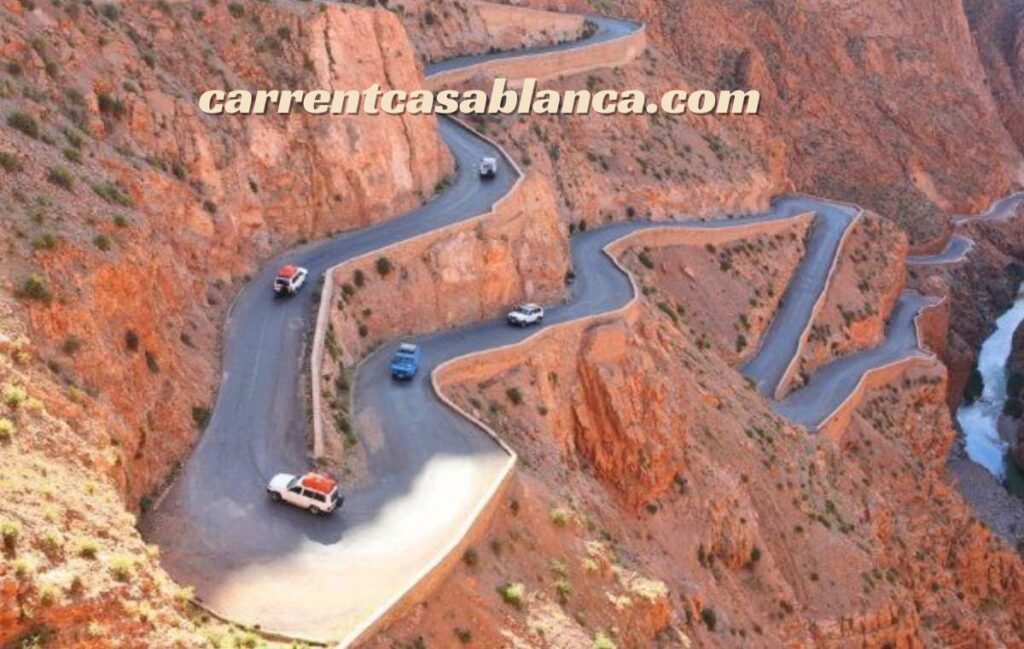
The Dadès Gorge is Morocco’s most dramatic canyon drive. The N10 brings you east through palm-fringed oases and rose-growing valleys (the region is famous for its rose festival in May), before the road tightens into the jaw-dropping gorge itself.
The upper section of the gorge features the legendary ‘monkey fingers’ rock formations – reddish towers of eroded rock that rise above the road like natural sculptures. Crumbling kasbahs dot the cliffside villages, and the air gets noticeably cooler as the canyon walls close in.
For drivers coming from Casablanca, a cheap car rental per day with an SUV option makes the 6-hour drive manageable and comfortable for the canyon terrain.
What surprised me: Spring brings wild flowers and monkey troops to the roadside – actual Barbary macaques that will investigate your car if you stop.
Mistake to avoid: Ignoring flash flood warnings. The canyon collects water fast. One client got stuck for 4 hours after an unexpected downpour. Always check weather before heading into the upper gorge.
3. Tizi n’Test Pass (R403) – The Dangerous Beauty
| Detail | Info |
|---|---|
| Distance | 160 km (Marrakech → Taroudant) |
| Drive Time | ~3.5–4 hours |
| Altitude | 2,100m at summit |
| Road Type | R403 – narrow, hairpin mountain road |
| Difficulty | Hard – not recommended for nervous drivers |
| Best Season | May to September |
| Recommended Vehicle | 4×4 strongly recommended |
The Tizi n’Test is the road that tests real drivers. It’s narrower than Tizi n’Tichka, less trafficked, and far more dramatic – with sections barely wide enough for two cars to pass and sheer drops on the edge. French engineers built this pass in the 1920s and it hasn’t changed much since.
At the summit, the ancient mosque of Tinmel sits in silent ruin – a thousand-year-old building accessible only from this road, which gives the route a quality you don’t find on more popular passes. The descent into the Souss Valley offers a completely different landscape: argan trees, dry plains, and eventually the sea.
For this road specifically, our 4×4 and SUV rental options from Casablanca are strongly recommended – a standard economy sedan will technically make it, but the peace of mind from a high-clearance vehicle is worth it.
What surprised me: The silence at the top is total. No traffic, no towns – just wind and an enormous view. Some of Morocco’s best photography happens at this summit.
Mistake to avoid: Attempting this in winter. The pass closes without warning when ice forms. Locals know to avoid it between November and April. One client attempted it in late October and turned back after the first kilometer of ice.
4. Todra Gorge Drive (R704) – Walls of Stone
The Todra Gorge sits at the eastern end of the High Atlas, where the Todra River has carved 300-meter rock walls that rise almost vertically from a narrow slot canyon. The drive through the lower gorge is accessible to any car – the road passes directly beneath the cliff faces on a well-maintained path.
What makes this route special is the combination with the Dadès Gorge. Many drivers tackle both in one day, entering the Dadès from the west and exiting via Todra to the east — a full canyon circuit that covers some of Morocco’s most concentrated scenery in 6–8 hours.
Drivers who prefer not to handle the return leg can use our one-way car rental service to set up a point-to-point journey with no backtracking required.
5. Agadir to Essaouira Coastal Road (N1) – Atlantic Edge Driving
| Detail | Info |
|---|---|
| Distance | ~175 km |
| Drive Time | ~2.5 hours |
| Road Type | N1 — paved coastal highway |
| Difficulty | Easy to Moderate |
| Best Season | Year-round (avoid summer midday heat) |
| Recommended Vehicle | Any car |
This is Morocco’s coastal showpiece. The N1 hugs the Atlantic between Agadir and Essaouira, passing through argan tree forests (unique to Morocco and protected by UNESCO), the famous Tamri dunes, and fishing villages where fresh catch is sold roadside.
Essaouira itself – with its whitewashed medina, wind-sculpted ramparts, and Gnawa music culture – is one of Morocco’s most distinctive towns. The approach from the south, with ocean on one side and argan forest on the other, makes the arrival feel genuinely earned.
6. Fes to Chefchaouen (via Rif Mountains, N8/N2) – The Blue City Approach
The drive from Fes to Chefchaouen threads through the Rif Mountains – a range that’s cooler, greener, and less visited than the Atlas. The road winds through cedar forests, Riffian villages where traditional striped wool dresses are still everyday clothing, and valleys that open suddenly to long views.
Chefchaouen’s famous blue-painted medina appears around a final bend – the contrast between the surrounding mountains and the blue-washed town is one of Morocco’s most striking arrivals by road. The approach from Fes takes approximately 3 hours and is most beautiful in morning light.
7. Route of 1,000 Kasbahs (Ouarzazate → Zagora via N9/N12) – Ancient Caravan Roads
East of Ouarzazate, the N9 and N12 trace ancient trans-Saharan caravan routes through a landscape of palm oases, fortified kasbahs, and the Draa Valley — one of Morocco’s longest rivers. This isn’t a single road but a network, and the best approach is to follow the Draa south from Ouarzazate toward Zagora.
The kasbahs along this route are among Morocco’s best-preserved – many are still inhabited by families who have lived in them for generations. The scale of the landscape changes constantly: the Draa Valley is lush and cultivated, while the plateaus above it are empty desert.
For multi-day explorations of this route, our car rental with driver services is popular among travelers who want local knowledge built into the journey — particularly useful for finding the smaller kasbah villages not marked on Google Maps.
8. Ourika Valley (R208) – The Perfect Day Trip from Marrakech
The Ourika Valley is 30 kilometers from Marrakech – close enough for a half-day trip but different enough in landscape to feel like a completely different Morocco. The R208 follows the Ourika River through Berber villages, terraced gardens, and a series of waterfalls at the valley’s head.
This is the best road for first-time drivers in Morocco. The R208 is smooth, well-signposted, and gentle – a good way to get comfortable with Moroccan driving conditions before attempting the larger passes. It’s also the safest high-altitude route in winter when the Atlas passes are closed.
9. Anti-Atlas: Tiznit to Tafraoute (R104/R106) – Morocco’s Hidden Gem
The Anti-Atlas Mountains are what most tourists miss and what most serious drivers eventually discover. The R104 from Tiznit climbs into a landscape of pink granite mountains, almond orchards, and painted rock formations that look unlike anything else in Morocco.
Tafraoute, the main town in the region, is surrounded by dramatic boulders and known for a controversial art installation – Belgian artist Jean Verame painted hundreds of boulders bright blue and red in the 1980s. The rock colors at sunset make this one of Morocco’s best photography locations.
10. Casablanca to El Jadida (N1) – Best Beginner Road in Morocco
If you’ve just picked up a rental car and want to ease into Moroccan driving before tackling the mountain passes, the N1 south from Casablanca to El Jadida is the ideal starting route. It’s a smooth coastal highway with clear signage, manageable traffic, and beach access at multiple points.
El Jadida itself features a remarkable Portuguese cistern – a flooded underground chamber that’s one of Morocco’s most unusual historical sites. The round trip from Casablanca is 200 km and can be done comfortably in half a day, making it a perfect shakedown drive for any vehicle.
Start from our Casablanca airport car rent desk or arrange hotel delivery in Casablanca – both options mean you’re on the N1 within minutes of picking up your keys.
All 10 Roads Compared at a Glance
| Road | Distance | Difficulty | Best For | Vehicle | Season |
|---|---|---|---|---|---|
| Tizi n’Tichka (N9) | 195 km | Moderate | Scenic + Cultural | SUV/Any | Apr–Oct |
| Dadès Gorge (N10) | 180 km | Moderate | Canyon Photography | SUV | Mar–Nov |
| Tizi n’Test (R403) | 160 km | Hard | Adventure Drivers | 4×4 | May–Sep |
| Todra Gorge (R704) | 100 km | Easy–Mod | Geology / Hiking | SUV | Mar–Nov |
| Agadir–Essaouira (N1) | 175 km | Easy | Coastal Scenery | Any | Year-round |
| Fes–Chefchaouen (N2) | 200 km | Easy–Mod | Green Mountains | Any | Apr–Oct |
| Route 1,000 Kasbahs | 300+ km | Moderate | History + Desert | SUV/4×4 | Oct–Apr |
| Ourika Valley (R208) | 60 km | Easy | Beginners + Winter | Any | Year-round |
| Anti-Atlas (R106) | 220 km | Easy | Photography | Any | Oct–Apr |
| Casa–El Jadida (N1) | 100 km | Easy | First-time Drivers | Any | Year-round |
Best Road by Driving Style (Quick Reference)
| Driving Style | Best Road | Why |
|---|---|---|
| Beginners | N1 Casa–El Jadida | Smooth highway, light traffic, forgiving |
| Scenic / Photography | Dadès Gorge N10 | Canyon walls, kasbahs, unique light |
| Adventure / Challenge | Tizi n’Test R403 | Hairpins, altitude, dramatic exposure |
| Families | Ourika Valley R208 | Waterfalls, short distances, safe bends |
| Desert Lovers | Route of 1,000 Kasbahs | Oases, dunes, ancient caravan atmosphere |
| Coastal Cruisers | Agadir–Essaouira N1 | Atlantic views, argan forests, surf towns |
| History Seekers | Tizi n’Tichka + Ait Benhaddou | UNESCO sites, film history, kasbahs |
| Winter Driving | Ourika R208 or N1 Coastal | Low altitude, no snow risk, year-round open |
Morocco Road Types and Conditions in 2026
Understanding Morocco’s road classification system prevents a lot of confusion – and helps you know what surface to expect before you arrive.
- N Roads (National): Morocco’s main highways. Well-paved, regularly maintained, dual-lane in many sections. Speed limit 80–100 km/h.
- R Roads (Regional): Paved but narrower, fewer guardrails, occasional patches. Speed limit 60–80 km/h. Standard cars handle these fine in good conditions.
- P Roads (Provincial): Narrow mountain and rural roads. Often one lane wide. Hairpins are common. 4×4 strongly recommended for long P-road sections.
- Piste (Unpaved): Desert tracks and off-road paths. 4×4 only. Not covered by standard rental insurance without prior arrangement.
Best Road Trips Starting from Casablanca
Casablanca is Morocco’s largest city and transport hub – and a smarter starting point than most guides acknowledge. Our car rental in Casablanca gives you direct access to the A3 motorway south to Marrakech (3 hours), the N1 coast (2 hours to El Jadida), and connecting routes to the entire country.
3-Day Loop from Casablanca:
- Day 1: N1 south → El Jadida → Essaouira (coastal warmup)
- Day 2: A3 → Marrakech → Tizi n’Tichka → Ouarzazate
- Day 3: Dadès Gorge → return via N10/A7
7-Day Expedition from Casablanca:
- Days 1–2: Coastal N1 → Essaouira → Agadir
- Day 3: Tizi n’Test pass → Marrakech
- Days 4–5: Tizi n’Tichka → Ouarzazate → Dadès + Todra gorges
- Day 6: N13 toward Merzouga (desert dunes)
- Day 7: Return via Ziz Valley → Casablanca
Fuel costs: approximately 15 MAD/liter. Budget 1,500–2,500 MAD for fuel on a 7-day trip. For full itinerary support, our car hire with hotel delivery in Casablanca ensures you start the journey refreshed rather than navigating airport logistics.
Essential Morocco Driving Tips (From 1,000+ Real Driver Experiences)
These aren’t generic tips lifted from a travel forum. They’re patterns we’ve observed across thousands of real road trips starting from Casablanca:
- Download offline maps before you leave. Signal drops in the Atlas Mountains and desert. Google Maps offline works well; Maps.me is excellent for rural R and P roads.
- Never pass a fuel station below half tank. On R and P roads south of Ouarzazate, stations can be 100+ km apart. This is the single most common mistake we see.
- Police checkpoints are routine — not a problem. Have your passport, driving license, and rental papers in one folder. Officers wave most tourists through within 30 seconds.
- Drive defensively on mountain passes. Trucks and local drivers move fast on roads you’re experiencing for the first time. Give them space; let them pass.
- Canyon roads after rain: wait 30 minutes. Flash floods in Morocco arrive without warning and recede quickly. If it’s rained recently, pause before entering a gorge and let local traffic flow first.
- Book a no-deposit rental to save upfront cash. Our no deposit car rental option is popular with travelers who need full budget flexibility.
- Use a credit-card-free rental if needed. Our car rental Morocco no credit card service removes the card requirement entirely – useful for travelers relying on debit or cash.
Frequently Asked Questions – Best roads to drive in Morocco
What are the best roads to drive in Morocco?
The best roads to drive in Morocco are Tizi n’Tichka Pass (N9) for mountain scenery, Dadès Gorge (N10) for canyon drama, Tizi n’Test (R403) for adventure, the Agadir–Essaouira coastal N1 for Atlantic views, and Ourika Valley (R208) for beginners. Each route covers a different landscape in a compact, driveable country.
Is driving in Morocco safe for tourists?
Yes, driving in Morocco is safe for tourists on main roads. The national (N) and regional (R) highways are well-maintained and suitable for standard cars. Key precautions: drive defensively on mountain passes, avoid canyon roads after heavy rain, download offline maps, and never drop below half a tank of fuel south of Ouarzazate.
Do I need a 4×4 to drive in Morocco?
You do not need a 4×4 for most Moroccan roads. Main routes – including Tizi n’Tichka Pass, the coastal N1, and Dadès Gorge – are paved and accessible with a standard car. A 4×4 is recommended only for Tizi n’Test, desert tracks near Merzouga, and unpaved Anti-Atlas pistes.
When is the best time to drive in Morocco?
The best time to drive in Morocco is spring (March–May) or autumn (September–November). Atlas passes are fully open, temperatures are comfortable, and the Dadès Valley rose harvest peaks in late April. Summer works for coastal and desert routes. Winter closes the High Atlas passes and raises flash flood risk in canyons.
How do I rent a car in Casablanca for a Morocco road trip?
To rent a car in Casablanca for a Morocco road trip, book online in advance and choose pickup at Mohammed V Airport (CMN) or hotel delivery in the city. Select an economy car for coastal and city routes, an SUV for Atlas passes, or a 4×4 for desert tracks. No deposit and no credit card options are available.
What are the most dangerous roads in Morocco?
The most dangerous roads in Morocco are Tizi n’Test Pass (R403) – a narrow 2,100m hairpin route – and the R502 High Atlas backroads, which carry flash flood and landslide risk after rain. The N15 Sahara fringe road is also hazardous due to sand drifts and absent emergency services.
Can I drive from Casablanca to Merzouga (Sahara)?
Yes, you can drive from Casablanca to Merzouga in the Sahara. The route covers approximately 550 km via the A3 motorway to Marrakech, then the N9 over Tizi n’Tichka Pass, continuing east on the N10. Plan for two days with an overnight stop in Ouarzazate. A 4×4 is recommended for Merzouga desert tracks.
Where to Start Your Morocco Road Trip
Morocco’s roads don’t just take you from place to place – they are the experience. The high passes, the canyon drives, the coastal highways and the desert tracks all carry their own character, their own risks, and their own rewards. No list can fully capture what it feels like to crest the Tizi n’Tichka at dawn or watch the Atlantic catch the last light from the N1.
Whatever route you choose, starting from Casablanca gives you the widest options, the best rental availability, and the most direct access to Morocco’s full road network. Explore our full fleet and Casablanca rental options – and if you’d prefer a local driver for the mountain roads, our chauffeur service in Casablanca pairs you with someone who has driven every road in this guide hundreds of times.
