How to Read Moroccan Road Signs for Foreign Drivers
Moroccan road signs follow a European-style system, so you can read most of them by shape and colour before you read a single word. Red circles ban or restrict something, triangles warn of a hazard, blue circles tell you what you must do, and rectangles give directions and services. The text is usually Arabic and French. Learn three French terms first: Sens interdit (no entry), Cédez le passage (give way) and Priorité à droite (priority to the right).
You’ve booked a rental car, and now you’re wondering how to read Moroccan road signs as a foreign driver, with Arabic on one line and French on the next.
Here’s the reassuring part. The symbols are mostly the ones you already know from Europe. What catches visitors out is the written text, a handful of French terms, and a few signs that don’t mean what you’d expect.
At Carrent Casablanca, we hand cars to first-time visitors, and the same questions come up every time. This guide answers them in the order you’ll meet them on the road: shapes, priority, vocabulary, speed, roundabouts and direction boards, then Casablanca’s own quirks like one-way streets, tram tracks and parking.
Read it once before you travel. Keep the tables on your phone, but only open them when you’re parked.
Where this guide comes from
We built it on Morocco’s official signage classification from the Ministry of Equipment and Water (the Instruction Générale sur la Signalisation Routière), the national road-sign order (Arrêté n° 2805-14) and the Code de la route (Law 52-05). Then we checked it against what we see on Casablanca’s streets.
Where a rule depends on the exact sign or junction, we say so instead of guessing. Signs and rules change, and the sign in front of you always beats any guide, this one included.
What Moroccan road signs look like
Morocco uses a French-influenced system built on the same principles as the Vienna Convention on Road Signs and Signals. That gives you triangular warning signs, round regulatory signs, blue mandatory signs and the red octagonal STOP.
If you’ve driven in Europe, most of it will feel familiar. If you’re from the US or Canada, the shapes are close enough to learn in an evening, and the tables below do the work.
Familiar shapes don’t replace reading the details, though. A speed number, a plate under the main sign or an arrow can change what you need to do.
Are Moroccan road signs in English?
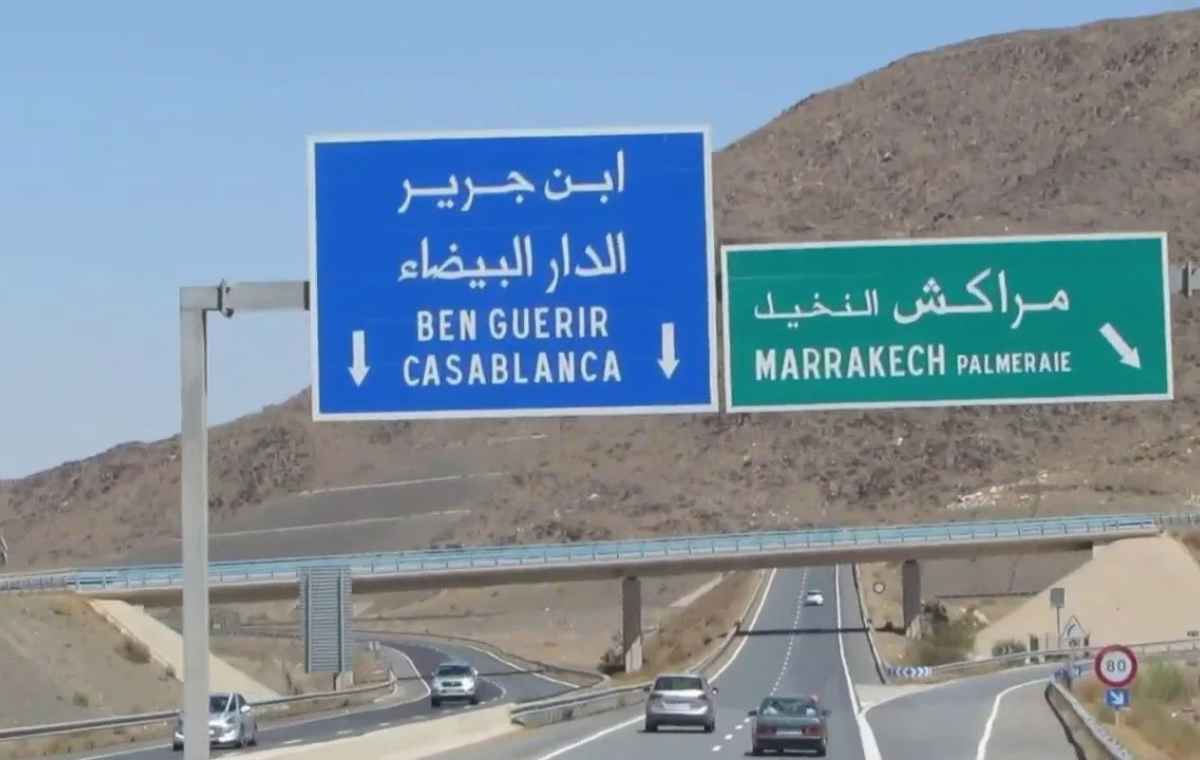
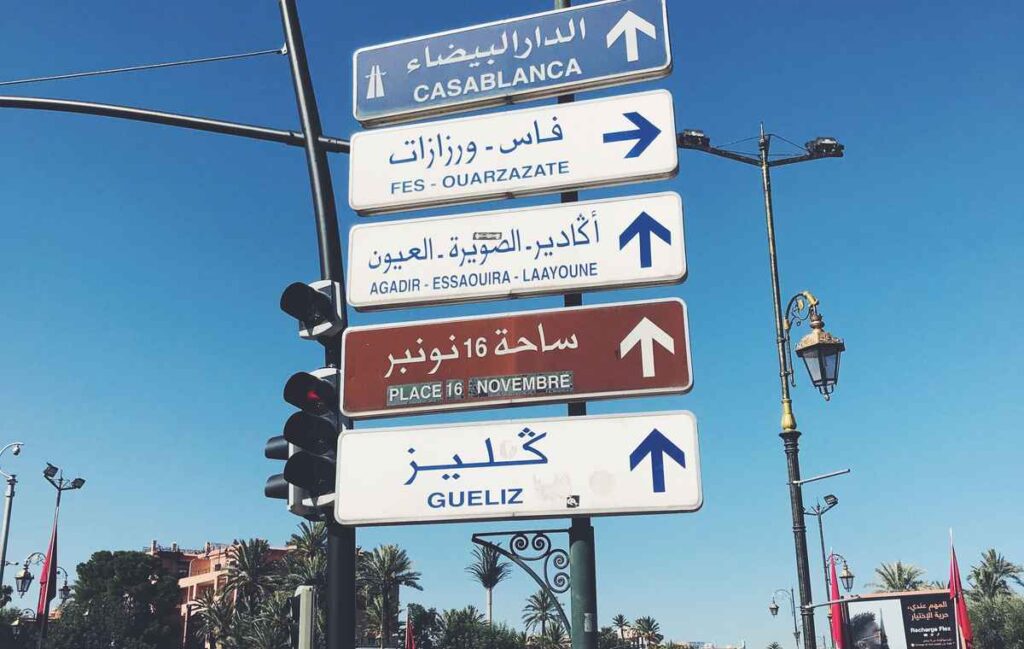
Not as a rule. Most signs use Arabic and French, and direction boards usually add Latin-script place names. English can appear at the airport, on major routes and in tourist areas, but don’t count on it.
In some places you’ll also see Tamazight written in Tifinagh script on official signage. You don’t need to read it. The symbol and the Latin place name will carry you.
Are Moroccan road signs the same as French road signs?
Very close in logic and design. That’s why French terms such as Sens interdit and Cédez le passage turn up in rental briefings and driving guides. Small details differ, so trust the symbol and the official meaning rather than your memory of France.
The 4-second method to read any Moroccan road sign
You won’t have time to decode a sign at 60 km/h. Use this order instead:
- Shape. Triangle, circle, octagon, upside-down triangle, diamond or rectangle.
- Colour. Red border, blue fill, yellow or orange for temporary roadworks.
- Symbol or number. A pedestrian, an arrow, a “60”.
- Text. Only if the first three didn’t settle it.
- Action. Slow down, stop, give way, don’t enter, change lane.
Three quick examples:
- Red circle + number = maximum speed in km/h.
- Red circle + white bar = no entry.
- Blue circle + white arrow = you must go that way.
If you can’t decode a sign in time, ease off, hold your lane and wait for the next sign or marking. Don’t brake hard or reverse on the road. That’s riskier than missing one sign.
The four families of Moroccan road signs
Morocco’s Ministry of Equipment and Water groups signs into four families. Most rental guides skip this, but it gives you a simple filing system for anything you see.
| Family | Official name (French) | What it looks like | What it tells you |
| Danger | Signalisation de danger | Red-bordered triangle | A hazard ahead. Slow down. |
| Intersections and priority | Intersections et priorités | STOP octagon, upside-down triangle, diamond | Who goes first. |
| Prescription | Signalisation de prescription | Round signs: red border = prohibition, blue = obligation | What you must not do, or must do. |
| Indication, service, direction | Signalisation d’indication | Rectangles and squares | Where you are, where to go, what’s nearby. |
Let’s take them one at a time.
Warning signs: the red-bordered triangle
A triangle means something ahead needs your attention. The picture inside says what: a bend, a junction, pedestrians, animals, falling rocks, a narrowing road, a slippery surface or roadworks.
It isn’t an order. It’s a heads-up. Lift off the accelerator, widen your gap and scan ahead.
In Casablanca, the ones you’ll see most are pedestrian crossings, junction warnings and speed bumps. Speed bumps (dos d’âne or ralentisseurs) are common on residential streets and near schools, and not all of them are well painted. Slow before the bump, not on it.
Out of town, on routes like those in our best roads to drive in Morocco guide, expect bend, steep-descent, falling-rock and animal signs. Sheep, goats and donkeys really do cross.
Priority and intersection signs: who goes first
This family decides who stops, who yields and who keeps rolling. Get it wrong and you’re the one in the accident report.
- STOP (red octagon): a full stop at the stop line. With no line, stop where you can see the junction. Check both directions and pedestrians, then go when it’s clear. No rolling.
- Cédez le passage (red-bordered upside-down triangle): give way. Slow down, be ready to stop and let priority traffic pass first.
- Priority road (yellow diamond): you have priority on this road until the sign ends. Keep watching anyway.
- End of priority (diamond with a diagonal bar): your automatic priority stops here.
- Priorité à droite: where no sign or marking applies, traffic coming from your right goes first.
Who has priority at an unsigned intersection in Morocco?
The vehicle approaching from your right. That’s priorité à droite, and it’s the rule visitors forget most.
Side streets often have no priority sign at all, so it applies more often than you’d think. Slow down at every unmarked junction and look right first.
And don’t assume the other driver knows it. If there’s doubt, let them go. Being right isn’t worth a scratch on a rental.
Prohibition signs: the red circle
A circle with a red border bans or limits something. The symbol inside tells you what.
- Speed limit: a number in a red circle. Maximum speed in km/h.
- Sens interdit (no entry): a solid red disc with a white horizontal bar. Don’t enter from this side.
- No overtaking: two cars side by side, one red. Stay behind.
- No parking and no stopping: blue discs with a red border. One diagonal bar means no parking. A red cross means no stopping or parking at all.
- End of restriction: the same sign in grey with diagonal lines through it. The earlier ban stops here.
The no-parking signs trip people up. They’re blue, so they look like a mandatory instruction, but the red border makes them prohibitions.
Mandatory signs: the blue circle
A blue circle with a white symbol is an order, not advice. Typical ones are turn right only, go straight only, keep right or left, and the roundabout sign with three arrows chasing each other. A blue circle with a number sets a minimum speed.
If a blue arrow points one way and your GPS says another, follow the sign. Sort out the map afterwards.
Sens interdit vs Sens unique: the mix-up that sends tourists the wrong way
These two get confused more than any others, and in a city full of one-way streets that’s a problem.
| Sens interdit | Sens unique | |
| Looks like | Red disc, white horizontal bar | Blue rectangle with a white arrow |
| Means | No entry from this side | One-way street. Traffic goes the way the arrow points |
| Where you see it | At the end of a street you must not enter | At the start of, or along, a street you can enter |
| What you do | Don’t enter. Find another route | Enter only if the arrow matches your direction |
Neither sign normally carries written words. Sens interdit is what the sign is called, and it’s what you’ll hear from locals and see in rental briefings.
Casablanca’s centre is full of one-way streets. Around Maarif, Gauthier, the Habous quarter and the streets near Casa Port, direction can flip from one block to the next. Staying in the area? Our car rental in Maarif page covers pickup there.
Phone maps in older districts can lag behind a recent change. If the app and the sign disagree, believe the sign.
If you realise you’ve turned into a street the wrong way, stay calm. Pull over where it’s safe, put your hazards on and let the GPS recalculate before you move again.
French and Arabic words on Moroccan signs: a translation table
You don’t need to speak French. You need about 20 words, and most are below. Take a screenshot.
Some of these appear on the signs themselves. Others show up on direction boards, parking panels and roadworks signs, and in directions from locals or your GPS.
| French | English | What you do |
| STOP / Arrêt | Stop | Come to a full stop |
| Cédez le passage | Give way | Yield to priority traffic |
| Sens interdit | No entry | Don’t enter |
| Sens unique | One way | Follow the arrow |
| Priorité à droite | Priority to the right | Give way to traffic on your right at unsigned junctions |
| Interdit de doubler | No overtaking | Stay behind |
| Stationnement interdit | No parking | Don’t park here |
| Arrêt et stationnement interdits | No stopping or parking | Don’t even stop |
| Ralentir | Slow down | Reduce speed |
| Dos d’âne / Ralentisseur | Speed bump | Slow right down |
| Travaux | Roadworks | Expect workers and lane changes |
| Déviation | Diversion | Follow the signed temporary route |
| Péage | Toll | Get your card or cash ready |
| Entrée / Sortie | Entrance / Exit | Enter or leave the road |
| Centre-ville | City centre | Follow for downtown |
| Toutes directions | All directions | General route for through traffic |
| Aéroport | Airport | Follow for Mohammed V |
| Gare | Train station | Follow for the station |
| Parking | Car park | Parking ahead |
| Danger | Danger | Hazard ahead. Take extra care |
Prefer to read this in French? Our team works in French too. See our page on location de voiture au Maroc.
Arabic words worth recognising
You don’t have to read Arabic script to drive here. But spotting a few repeated words helps when a board has no Latin text.
| Arabic | Sounds like | Meaning |
| قف | Qif | Stop |
| ممنوع الدخول | Mamnūʿ ad-dukhūl | No entry |
| اتجاه واحد | Ittijāh wāḥid | One way |
| مدخل / مخرج | Madkhal / Makhraj | Entrance / Exit |
| الطريق السيار | aṭ-Ṭarīq as-sayyār | Autoroute (motorway) |
| مطار | Maṭār | Airport |
And the cities you’re most likely to chase on a board:
| Latin spelling | Arabic |
| Casablanca | الدار البيضاء |
| Rabat | الرباط |
| Marrakech | مراكش |
| Agadir | أكادير |
| Fès | فاس |
Spelling won’t always match your GPS. You’ll see Fès on a board and Fez on your phone, or Tanger and Tangier. Match the first few letters and the route number, not the full spelling.
Speed limit signs and radar warnings
A red circle with a number is the maximum speed in km/h, from that sign until another speed sign or an end-of-restriction sign. The posted number beats your GPS, the car behind you and the default limit.
When nothing is posted, the usual defaults are 60 km/h in built-up areas, 100 km/h on open roads and 120 km/h on autoroutes. Near schools and crossings, limits often drop lower. We cover the wider picture in our driving in Morocco tips.
Speed enforcement uses fixed and mobile radar, and police can also work with handheld units. Warning signs exist, but you can’t rely on them. The simple fix: drive at the posted limit everywhere and you never have to spot a camera.
Limits change quickly on the Corniche and the big boulevards in Casablanca, so read every number. Taking the seafront route? Our Ain Diab coastal drive guide shows where to take it slowly.
Roundabout signs: how to read the entry before you commit
Roundabouts worry foreign drivers most, and that’s fair. Morocco has a lot of them, and not every one is signed the same way.
The rule that keeps you safe: follow the sign or marking at the entry first. Where there’s none, fall back on the general priority rules. Don’t carry one roundabout’s rule to the next.
- Slow down as soon as you see the roundabout warning sign.
- Look at the entry. A Cédez le passage sign or triangle markings on the road mean you yield.
- Give way to traffic already circulating when the entry is signed that way.
- Enter and travel anticlockwise. Morocco drives on the right.
- Choose your lane early. Don’t cut across.
- Signal right before your exit and check your mirror.
A blue circle with three white arrows tells you which way traffic must circulate. A warning triangle with the same arrows only tells you a roundabout is ahead.
Expect other drivers to exit without signalling or to cut across lanes. Leave space, and don’t trust an indicator you haven’t seen.
For wider rules and rental-specific advice, see our guide to driving a rental car in Morocco and our honest answer to is it safe to drive in Morocco.
Direction boards and autoroute signs: how to read them early
Direction signs are rectangles with a destination, a route number, a distance and an arrow. They’re where most foreign drivers lose confidence, because the writing is smaller and the decisions come faster.
Read them in this order:
- Destination name. Look for the next major city, not the small towns.
- Route number. National roads start with N, regional roads with R, provincial roads with P, and autoroutes with A.
- Arrow or lane. Overhead boards usually tell you which lane to be in.
- Distance. Shown in kilometres.
Do it early. The board before an interchange is your decision point. By the time you see the exit itself, it’s often too late to move over safely.
What to do if you miss an exit
Keep going. Don’t stop, don’t reverse, don’t cut across the painted area. The next exit and your GPS will bring you back. A missed exit is a detour, not an emergency.
Toll signs (péage)
Autoroute toll plazas are announced in advance. Pick a lane marked for cash or card. Lanes marked for the Jawaz electronic tag are for cars fitted with one, so ask at pickup whether yours has it.
Keep a card and some small cash within reach before you get to the plaza, not while you’re queuing.
From Mohammed V Airport to central Casablanca
The airport is in Nouaceur, roughly 30 km from the city centre. Here’s how to read the road:
- Leave the airport area following the Casablanca boards.
- At the first interchange, check the board before choosing a lane. Casablanca, Marrakech and Rabat point in different directions.
- Stay on the Casablanca and Centre-ville signs, and expect a toll plaza if your route uses the autoroute.
- As you enter the city, switch from highway-style boards to street-level signs, and watch for one-way streets.
Our Casablanca airport car rental guide walks through pickup and the first ten minutes in more detail.
Reading boards for the big routes out of Casablanca
- To Rabat: follow Rabat north. Our Casablanca to Rabat notes cover the route.
- To Marrakech: follow Marrakech south. See Casablanca to Marrakech by car.
- To Agadir: you’ll follow Marrakech boards first, then Agadir. Our Casablanca to Agadir road trip guide has the details.
Casablanca street quirks the signs don’t tell you about
Signs cover the rules. They don’t cover how the city actually moves. These are the situations our renters ask about most.
Do trams have priority in Casablanca?
Treat the tram as having priority everywhere. It can’t swerve and it can’t stop quickly.
Never stop or park on the tracks, and don’t queue across them. Around Casa Port and Casa Voyageurs stations you’ll share space with tracks, stops and pedestrians who step out without looking. Follow the signals at crossings, and look both ways even on green.
Bus lanes, taxis and scooters
Bus lanes are marked by signs and paint. Stay out of them. Buses pull out with priority and passengers step off into the road, so leave room.
Red petits taxis stop without warning to pick up or drop off, and white grands taxis do the same on main roads. Keep a gap and don’t tailgate.
Scooters filter through on both sides, so check your mirror and blind spot before every turn. Early in the day, coastal mist can roll in along the Corniche. If visibility drops, slow down and use dipped lights.
Still deciding whether you need a car in the centre at all? Our comparison of getting around Casablanca by car vs taxi is blunt about it.
Parking signs in Casablanca: read the sign, the plate and the markings
Parking is where visitors lose time and money. Read three things together: the sign, the plate underneath it and the markings on the road.
- Blue square with a white P: parking is allowed, subject to any plate underneath.
- Blue disc, red border, one bar: no parking.
- Blue disc, red border, red cross: no stopping or parking.
- Plates and arrows: they show where a restriction starts, ends or continues, and sometimes the days or hours it applies.
Street parking in central Casablanca is often watched by informal attendants in vests, who expect a few dirhams when you leave. Some central streets also use paid parking, so look for a meter or a sign.
Never park on tram tracks, at bus stops, in front of garage doors or on a crossing. Other cars being there doesn’t make it legal.
Before you walk away, photograph your car and the nearest signs. Collecting from the station? Our page on car rental near Casablanca train station has the practical details.
Roadworks, diversions and temporary signs
Yellow or orange signs, cones and barriers override the permanent signs beneath them. A temporary speed limit beats the normal one until the works end.
Travaux means roadworks. Déviation means follow the signed detour. If a line of cones shifts you into another lane, follow it, even when the old markings say otherwise. When two instructions clash, take the more restrictive one and slow down.
Police checkpoints and hand signals
An officer’s hand signal overrides every sign and traffic light. If a police officer or gendarme is directing traffic, follow them, not the signal.
Checkpoints are common on roads between towns and at some city entrances. Slow down as you approach, don’t overtake nearby and keep your lane until you’re signalled.
If you’re waved over, pull in safely, switch off the engine, keep your hands visible and stay polite. Keep your passport, driving licence, rental agreement and insurance papers within reach. Our list of documents needed to rent a car in Morocco covers the full set.
Licence questions? See our guides on driving with a UK licence, a foreign licence or a US driver’s licence.
If you’re told you owe a fine, ask for the official document or receipt. Don’t hand over cash without one.
Common mistakes tourists make with Moroccan road signs
| The mistake | What the sign actually means |
| Treating Sens interdit as a one-way sign | It means do not enter from this side |
| Assuming every roundabout has the same priority | Read the entry sign or marking at each one |
| Ignoring an end-of-restriction sign | The earlier restriction ends only where this sign says |
| Treating a warning triangle as a rule | It’s a hazard warning. Adjust your speed and attention |
| Confusing no parking with no stopping | The crossed sign is stricter. Don’t even pause |
| Following the GPS into a one-way street | Check the sign and the layout of the street first |
| Forgetting priorité à droite | At unsigned junctions, traffic from the right goes first |
How to read Moroccan road signs for foreign drivers: your 10-sign checklist
Run through this in the car park before you leave. If you can say what each one means, you’re ready.
- STOP octagon
- Cédez le passage (red-bordered upside-down triangle)
- Sens interdit (red disc, white bar)
- Sens unique (blue rectangle, white arrow)
- Speed limit (red circle with a number)
- Blue circle with arrows (mandatory direction)
- Roundabout (three arrows in a circle)
- No parking vs no stopping
- Priority diamond and its end sign
- Péage, Sortie and Centre-ville boards
Then load your route and an offline map before you move, and know where your documents are. Read the rental agreement and damage report properly. Our guide to avoiding rental car scams in Morocco shows what to check.
Check what your cover includes in our guide to insurance options for rental cars in Morocco. And save what to do if your rental car breaks down in Morocco before you need it.
Questions before you set off? Carrent Casablanca is easy to reach. Ask us anything at pickup.
Choosing a car that makes sign-reading easier
In one-way streets and tight parking, smaller is easier. A compact car in the Dacia Logan or Renault Clio class turns easily and fits gaps bigger cars skip. See our economy car rental in Casablanca options, or our rundown of the best cars for driving in Casablanca.
An automatic car takes one job off your list at roundabouts and in stop-start traffic, which leaves more attention for signs.
Travelling with family? Our guide to the best SUV to rent in Casablanca for families helps you choose. Heading into the Atlas or the desert? Look at 4×4 rental in Morocco.
On a tight budget? Read the cheapest way to rent a car in Casablanca. Not keen to read signs at all? Compare car rental with a driver vs self-drive in Casablanca before you decide.
Frequently asked questions about Moroccan road signs
What does a red circle mean on Moroccan roads?
A red-bordered circle is a prohibition or restriction, such as a speed limit, no overtaking or no entry. The symbol or number inside tells you which. A solid red disc with a white bar means no entry.
What does a blue circle mean in Morocco?
A blue circle with a white symbol is a mandatory instruction, such as a required direction, a roundabout circulation direction or a minimum speed. Follow it like an order. A blue disc with a red border is different: it bans parking or stopping.
What does a triangle road sign mean in Morocco?
A red-bordered triangle warns of a hazard ahead. Slow down and read the symbol inside. An upside-down triangle is different: it means give way.
What does “Sens interdit” mean?
It means no entry. The sign is a red disc with a white horizontal bar. Don’t drive into the street from that side.
What are the most important road signs for tourists in Morocco?
Learn STOP, Cédez le passage, Sens interdit, speed-limit circles and the roundabout entry sign first. Then remember priorité à droite for unsigned junctions.
Are Moroccan speed limits shown in km/h?
Yes. Speed signs use km/h, and the posted number overrides any default or GPS figure.
Can I turn right on a red light in Morocco?
No. Treat red as stop. Turn only on green, or when a separate signal clearly allows it.
Who has priority at Moroccan roundabouts?
It depends on the entry. Follow the sign or marking first. Where a give-way sign applies, yield to traffic already in the roundabout. Where nothing is posted, apply the general priority rules.
Should I hire a driver instead of reading the signs myself?
If city traffic worries you, it’s a fair option. Compare car rental with a driver vs self-drive in Casablanca to see which suits your trip.
Is driving in Casablanca hard for first-timers?
It’s busy rather than impossible. Plan your first drive for a quiet hour and keep the route simple. Our guide on renting a car in Morocco for first-timers and these tips for car rental in Casablanca will help.
